The GCE O-Level ends with the 2026 exams. From 2027, Sec 4 students in Singapore sit the Singapore-Cambridge Secondary Education Certificate (SEC), which reports each subject at G1, G2 or G3; G3 papers keep the O-Level format, standard and A1 to 9 grades. This guide covers the exam calendar, grading, results day, the move from L1R5 to L1R4 for JC entry, the new subject codes and each main subject. Facts are as at November 2026, from SEAB and MOE.
Which part do you need?
- Sec 4 in 2026 (the last O-Level cohort): results day and the 2027 JAE scores.
- Sec 3 in 2026 (the first SEC cohort): what the SEC changes and the 2027 exam calendar.
- Sec 2, choosing Sec 3 subjects: A-Maths, pure or combined science and what JC entry will need from 2028.
In this guide: O-Level vs SEC · subject codes · exam dates · grading · results day · L1R5 and L1R4 · maths · English · science · is it hard? · private candidates · our classes · FAQ
What is the SEC, and how is it different from the O-Level?
The SEC is the national exam that replaces the GCE O-, N(A)- and N(T)-Levels from 2027. It is run jointly by SEAB, MOE and Cambridge International Education, like the O-Level. MOE says students take the GCE O- and N-Level exams until 2026, and the SEC applies from the 2024 Secondary 1 cohort onwards. SEAB says the mode of assessment and the overall standard of the exams stay the same.
| O-Level (2026 and earlier) | SEC (from 2027) | |
|---|---|---|
| Certificate | GCE O-Level, with separate N(A)- and N(T)-Level certificates | One Singapore-Cambridge SEC listing each subject and its level |
| Subject levels | O-Level, N(A)-Level, N(T)-Level | G3 (O-Level standard), G2 (N(A)-Level standard), G1 (N(T)-Level standard) |
| Grades | A1 to 9 at O-Level | A1 to 9 at G3; 1 to 6 at G2; A to E at G1 |
| English written papers | With the other written papers, October to November | September |
| Mother Tongue written papers | A mid-year sitting, plus a second sitting in the year-end period | One sitting in September; the last mid-year sitting was in 2026 |
| Other written papers | Mid-October to mid-November | One common period from October |
| Results | January of the following year | January of the following year |
| Subject codes | Four digits, for example 4052 for Mathematics | K-codes, for example K310 for G3 Mathematics |
| JC entry | L1R5 of 20 or below (2027 JAE) | L1R4 of 16 or below, every aggregate subject at G3 (from 2028) |
Checked on 23 November 2026 against SEAB’s SEC page, MOE’s Full SBB FAQ and MOE’s March 2024 infosheet on the SEC timetable.
An O-Level certificate stays valid after 2027. For admission from 2028, MOE treats an O-Level grade as equivalent to the same grade at G3.
Which subject codes change under the SEC?
Every subject has a new SEC code from 2027. For the main maths and science subjects we compared word by word, the G3 syllabus content matches the O-Level syllabus it replaces, apart from small wording changes in some practical notes, so O-Level past papers remain good practice for G3.
| Subject | O-Level code (2026 and earlier) | SEC G3 code (2027) | Also offered at G2 or G1 |
|---|---|---|---|
| English Language | 1184 | K300 | Yes (see SEAB’s G2 and G1 lists) |
| Mathematics (E-Maths) | 4052 | K310 | G2 K210 (was 4045); G1 K110 (was 4046) |
| Additional Mathematics (A-Maths) | 4049 | K341 | G2 K232 (was 4051) |
| Physics | 6091 | K323 | G3 only |
| Chemistry | 6092 | K324 | G3 only |
| Biology | 6093 | K325 | G3 only |
| Science (Physics, Chemistry) | 5086 | K326 | G2 combined science K223 to K225 (were 5105 to 5107); G1 Science K123 (was 5148) |
| Science (Physics, Biology) | 5087 | K327 | As above |
| Science (Chemistry, Biology) | 5088 | K328 | As above |
| Geography | 2279 | K329 | See SEAB’s lists |
| History (an e-Examination subject) | 2174 | K330 | See SEAB’s lists |
| Literature in English | 2065 | K331 | See SEAB’s lists |
| Humanities (Social Studies, Geography) | 2260 | K335 | See SEAB’s lists |
| Humanities (Social Studies, History) | 2261 | K336 | See SEAB’s lists |
| Humanities (Social Studies, Literature in English) | 2262 | K337 | See SEAB’s lists |
| Principles of Accounts | 7087 | K342 | See SEAB’s lists |
| Computing | 7155 | K349 | See SEAB’s lists |
| Chinese / Higher Chinese | 1160 / 1116 | K320 / K355 | See SEAB’s lists |
| Malay / Higher Malay | 1148 / 1117 | K321 / K356 | See SEAB’s lists |
| Tamil / Higher Tamil | 1157 / 1147 | K322 / K357 | See SEAB’s lists |
Checked on 23 November 2026 against SEAB’s list of G3 syllabuses for school candidates (2027), which gives every G3 code with its 2026 code.
When are the O-Level and SEC exams?
The last O-Level written papers ran from October to November 2026, with results due in January 2027. The first SEC follows a new pattern in 2027, and SEAB had not published the exact 2027 dates as at November 2026.
| When | 2026 O-Level (the last) | 2027 SEC (the first) |
|---|---|---|
| Mid-year | Mother Tongue mid-year sitting (the last one) | No mid-year sitting |
| Before the written papers | Oral, listening and practical exams | Oral, listening and practical exams |
| September | None | English and Mother Tongue written papers, in one sitting |
| October to November | All written papers, mid-October to mid-November | All other written papers, in one period from October |
| Results | 13 to 15 January 2027 (tentative) | January 2028 |
Checked on 23 November 2026 against MOE’s national exam dates page and SEAB’s SEC page. We will add the 2027 dates when SEAB publishes them.
What it means for revision in 2027: a Sec 4 student finishes English and Mother Tongue in September, a few weeks before the maths, science and humanities papers. Plan two phases: English and Mother Tongue peak in August, then maths, sciences and humanities carry through September and October.
How are O-Level and SEC subjects graded?
G3 subjects, like the O-Level, are graded from A1 (best) to 9, and grades A1 to C6 are passes. MOE restated this pass line in a written parliamentary reply in May 2026. G2 subjects are graded 1 to 6 and G1 subjects A to E, the same scales as the N(A)- and N(T)-Levels.
| Grade | Points in an aggregate | Pass? | Marks most schools use for their own tests |
|---|---|---|---|
| A1 | 1 | Yes | 75 and above |
| A2 | 2 | Yes | 70 to 74 |
| B3 | 3 | Yes | 65 to 69 |
| B4 | 4 | Yes | 60 to 64 |
| C5 | 5 | Yes | 55 to 59 |
| C6 | 6 | Yes | 50 to 54 |
| D7 | 7 | No | 45 to 49 |
| E8 | 8 | No | 40 to 44 |
| 9 | 9 | No | Below 40 |
The mark ranges are school practice for school exams. SEAB’s grade descriptions for the national exam do not include mark ranges.
Grades count twice for admission. First as points in an aggregate (lower is better). Second as minimum grades in named subjects: for JC, MOE requires English at C6 or better and E-Maths or A-Maths at D7 or better, so a D7 in maths meets the requirement while a D7 in English does not. Where an aggregate mixes levels, as polytechnic admission will from 2028, MOE maps G3 grades onto the G2 scale: A1 to B3 become 1, B4 to C6 become 2, D7 becomes 3, E8 becomes 4 and 9 becomes 5.
What happens on O-Level results day in January 2027?
MOE’s tentative window for the 2026 O-Level results is Wednesday 13 to Friday 15 January 2027, and MOE confirms the exact day nearer the time. Results day also starts the Joint Admissions Exercise (JAE) for JC, Millennia Institute (MI), polytechnic and ITE.
| When | What happens |
|---|---|
| Results day, afternoon | School candidates collect their results at school. Private candidates view theirs on SEAB’s Candidates Portal. |
| Results day, afternoon | MOE emails each student about JAE eligibility. Eligible students receive Form A, which shows their gross aggregate scores for JC, MI, polytechnic and ITE, and the courses they can apply for. |
| From 4pm on results day | JAE applications open for six calendar days and close at 4.30pm on the last day. |
| 9am, Tue 2 Feb 2027 (tentative) | JAE posting results, through JAE-IS and SMS. |
| 2 to 5 Feb 2027 (tentative) | Appeals for polytechnic and ITE courses on the JAE Online Appeal Portal. For JC or MI, students approach the school directly. |
Checked on 23 November 2026 against MOE’s JAE page. We will update this table when MOE confirms the results date.
Before results day, draft a list of choices with a few safe options. Our 2026 JC cut-off points page lists last year’s ranges; MOE notes that past ranges are a reference only and do not guarantee admission.
L1R5 or L1R4: how are JC, MI and polytechnic scores worked out?
Students with 2026 O-Level results apply in the 2027 JAE under the current rules. The first SEC cohort applies from 2028 under new rules, which MOE announced in 2024 and 2025.
| Route | 2027 JAE (2026 O-Level results) | From 2028 (2027 SEC results) |
|---|---|---|
| Junior college | L1R5 gross aggregate of 20 or below; English C6 or better; maths D7 or better | L1R4 gross aggregate of 16 or below, every aggregate subject at G3; English C6 or better; maths D7 or better; Mother Tongue D7 or better at G3, or 1 to 5 at G2 |
| Millennia Institute | L1R4 of 20 or below | L1R4 of 20 or below, every aggregate subject at G3 |
| Polytechnic | ELR2B2 net aggregate of 26 or below (28 for Nursing) | Four G3 subjects and one G2 subject; net cut-off 22 (24 for Nursing) |
Checked on 23 November 2026 against MOE’s JAE pages, MOE’s page on JC and MI admission from the 2028 PSE, and MOE’s March 2024 and March 2025 infosheets.
What the letters mean. L1 is English or Higher Mother Tongue. R1 is the best humanities subject, R2 the best maths or science subject, R3 the best remaining humanities, maths or science subject, and R4 and R5 the best two remaining subjects (Religious Knowledge does not count). L1R4 is the same without R5. Lower is better. The gross score decides whether a student is eligible; bonus points are then subtracted to give the net score, which decides where they are posted.
Worked example (an illustrative student, not real results):
| Subject | Grade | Counts in L1R5 as | Counts in L1R4 as |
|---|---|---|---|
| English Language | B3 (3) | L1: 3 | L1: 3 |
| Humanities (Social Studies, Geography) | C5 (5) | R1: 5 | R1: 5 |
| Mathematics | A1 (1) | R2: 1 | R2: 1 |
| Additional Mathematics | A2 (2) | R3: 2 | R3: 2 |
| Chemistry | B3 (3) | R4: 3 | R4: 3 |
| Physics | B4 (4) | R5: 4 | Not counted |
| Chinese | B4 (4) | Not counted | Not counted |
| Total | 18 (meets JC: 20 or below) | 14 (meets JC: 16 or below) |
What the change means. For the same grades, the L1R4 score is the L1R5 score minus the weaker of the two subjects in R4 and R5. So a student whose L1R5 is exactly 20 would meet the new JC bar of 16 only if that dropped subject was B4 or weaker. The bigger change is the level rule: from 2028, a subject taken at G2 cannot count in the JC aggregate at all, which is why Sec 2 subject choices matter.
For what students take in JC, see our JC subject combinations guide.
O-Level and SEC maths: E-Maths and A-Maths
Most students take Mathematics (E-Maths), and many add Additional Mathematics (A-Maths). From 2027 they are SEC G3 Mathematics (K310) and G3 Additional Mathematics (K341).
| E-Maths (K310) | A-Maths (K341) | |
|---|---|---|
| Papers | 2 papers, 2 h 15 min each | 2 papers, 2 h 15 min each |
| Formulae | Some formulae provided in the exam | Some formulae provided in the exam |
| Leads to | Needed for almost every post-secondary route | The usual base for H2 Mathematics in JC |
A-Maths is where most students feel the jump: algebra has to be fluent before calculus and trigonometry make sense. MOE’s H2 Mathematics syllabus assumes G3 Additional Mathematics, although students without it may still take H2 Mathematics and bridge the gap in JC. Schools decide who takes A-Maths in Sec 3 using Sec 2 results; for example, Peirce Secondary asks for at least B4 in Sec 2 G3 Mathematics, and St Patrick’s School for 60% or more.
For classes, see our O-Level and SEC maths classes page.
O-Level and SEC English: papers, oral and the September move
SEC G3 English Language (K300) has four papers in SEAB’s 2027 syllabus:
| Paper | What it tests | Time |
|---|---|---|
| Paper 1 | Writing (70 marks) | 1 h 50 min |
| Paper 2 | Comprehension (50 marks) | 1 h 50 min |
| Paper 3 | Listening (30 marks) | About 45 min |
| Paper 4 | Oral Communication (30 marks) | About 20 min, including 10 min preparation |
The syllabus says the oral exam is delivered by computer. Papers 1 and 2 move to September from 2027, so English revision peaks in August rather than October. English improves slowly, which is why it rewards steady, marked practice over a last-minute push.
See our O-Level and SEC English page.
O-Level and SEC science: pure or combined, and practicals
At G3, students take sciences as pure subjects (Physics K323, Chemistry K324, Biology K325) or as a combined science. SEAB names the combined options by their parts: Science (Physics, Chemistry) K326, Science (Physics, Biology) K327 and Science (Chemistry, Biology) K328. At G2, science is combined science only, so pure sciences need G3.
Practical skills are examined too. In G3 Physics (K323), for example, Paper 3 is a 1 h 50 min practical test worth 20% of the subject, sat before the written papers.
The pure or combined choice is made at the end of Sec 2, and each school sets its own bar. For Sec 3 in 2027, Peirce Secondary asks for at least B4 in Sec 2 G3 Science for double pure science, and St Patrick’s School asks for 75% or more in Sec 2 G3 Science with more than 60% in G3 Maths.
Physics carries on as H2 Physics in JC.
Is the O-Level hard, and which subject is hardest?
It depends on the student, and no official figures rank subjects by difficulty, so the most useful guide is your child’s own test scripts. Three subjects come up most often with families:
- A-Maths moves quickly from algebra into calculus and trigonometry, and weak algebra shows up in every topic.
- English is the slowest to improve, and from 2027 its papers come a month earlier.
- Physics asks students to apply ideas to unfamiliar situations, and its practical is a separate paper.
Can private candidates take the SEC?
Yes. From 2027 the SEC replaces the O-Level for private candidates as well as school candidates, at the same standard for each level. Private candidates register with SEAB, and today they view O-Level results on SEAB’s Candidates Portal. Private candidates who apply through the admissions exercise remain eligible for bonus points where they apply. See our page on taking national exams as a private candidate.
After the O-Levels: JC, MI or polytechnic?
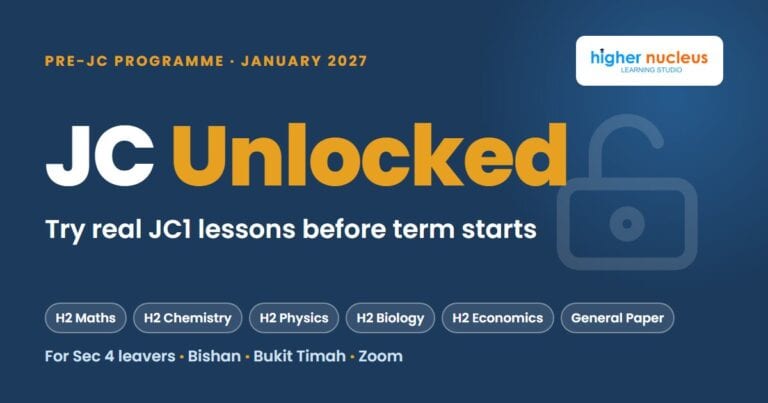
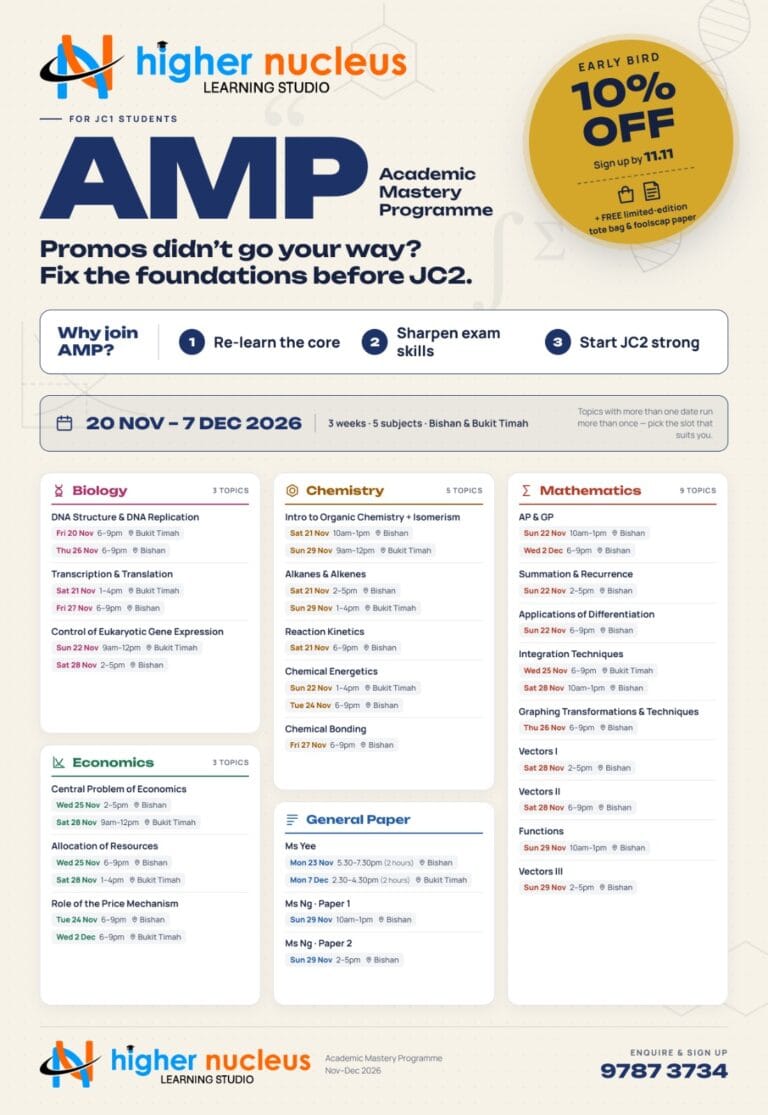
JC is a two-year A-Level course, MI a three-year A-Level course, and polytechnic a three-year diploma; ITE offers Higher Nitec courses. The scores each route needs are in the L1R5 and L1R4 section above. For students heading to JC, JC1 moves quickly in the first term, and our Pre-JC Bridging Programme gives a head start.
O-Level or IGCSE?
Both are taken at about age 16, but they serve different students. The O-Level, and from 2027 the SEC, is Singapore’s national exam and the qualification MOE uses for JC, MI and polytechnic admission. The IGCSE is Cambridge’s international qualification, usually taken at international schools before the IB Diploma or A-Levels. If you are weighing an international route, our IB or A-Levels guide compares the next stage.
Is O-Level tuition worth it, and how do you choose?
It is worth it when there is a clear reason: a subject that has fallen behind (A-Maths is the usual one), a student who understands lessons but loses marks on written answers, or a Sec 4 student who needs structured exam practice. It is probably not needed when a student is coping and gets useful feedback from school. If you do look for a tutor, four things matter more than the advert:
- The current syllabus. From 2027 the codes are new (for example K310 for E-Maths), so check that notes and practice papers match.
- A plan beyond this week’s homework, running to the exam.
- Written work that is marked, with specific feedback, not just answers.
- A format that suits the child: a small group for pace and practice, or one-to-one for a narrow gap.
Our guide on how to choose a reliable tutor compares the types of tutor.
Secondary classes at Higher Nucleus
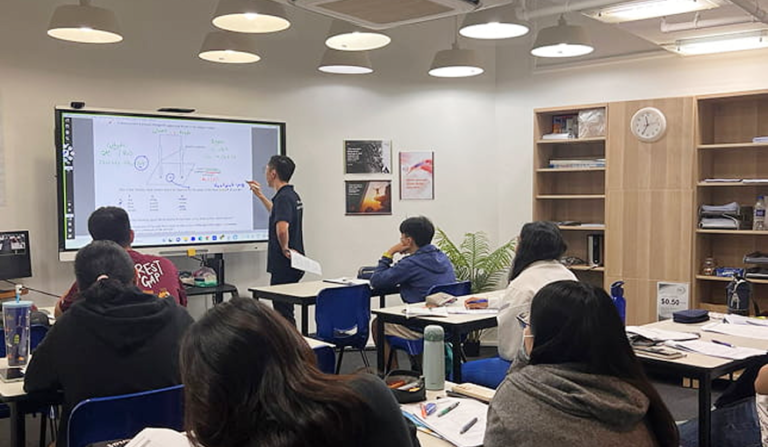
Higher Nucleus Learning Studio (HNLS) is a centre led by current and former MOE JC teachers. Our secondary classes are small group classes:
| Subject | Level | 2027 |
|---|---|---|
| A/E Maths | Sec 3 and Sec 4 (G3) | Running on Saturdays at our Bishan centre |
| Lower Secondary Maths | Sec 1 and Sec 2 (G3 and G2) | Running on Tuesdays at our Bishan centre |
| English | Sec 3 and Sec 4 | Planned for 2027 |
| Physics | Sec 3 and Sec 4 | Planned for 2027 |
Every class can also be joined live on Zoom. 1-to-1 sessions are available, and a trial lesson is available if you’d like to see a class first. Check the days, times and branch for each class on our secondary class schedules page.
Frequently asked questions
Is 2026 the last year of the O-Levels?
Yes. MOE says students take the GCE O-Level until 2026. From 2027, the O-, N(A)- and N(T)-Levels are combined into the Singapore-Cambridge Secondary Education Certificate (SEC), for school and private candidates. G3 subjects in the SEC keep the O-Level standard and the same A1 to 9 grades.
When are the 2027 SEC exams?
Oral, listening and practical exams come first, then the English and Mother Tongue written papers in September, then all other written papers in one period from October. Results are released in January 2028. SEAB had not published the exact 2027 dates as at November 2026.
What is the passing grade for O-Level and SEC G3 subjects?
Grades A1 to C6 are passes, and D7, E8 and 9 are not. G2 subjects are graded 1 to 6 and G1 subjects A to E. For JC, MOE also requires English at C6 or better and maths at D7 or better.
Can my child use O-Level past papers for the SEC?
Yes, for G3 subjects. SEAB says the mode of assessment and overall standard of the SEC are the same as the O-Level, and the main maths and science syllabuses we compared match their O-Level versions in content. Check each subject’s 2027 SEAB syllabus for its paper format.
Is L1R4 harder than L1R5?
Not for the same grades in most cases. The L1R4 score is the L1R5 score minus the weaker of the R4 and R5 subjects, and the JC bar falls from 20 to 16, so a student at exactly 20 on L1R5 meets it only if that subject was B4 or weaker. The bigger change is that every subject in the JC aggregate must be at G3 from 2028.
When should my child start O-Level tuition?
Sec 3 is a natural start for A-Maths and the sciences, when the new content begins and gaps are easiest to fix. Starting in Sec 4 can still help with exam practice, but there is less time to rebuild a weak topic. From 2027, English papers in September also bring the English deadline forward.
Is there O-Level tuition in Bishan or Bukit Timah?
Our 2027 secondary maths classes run at our Bishan centre, near Bishan MRT, and every class can also be joined live on Zoom. English and Physics are planned for 2027, and the secondary class schedules page will show their days, times and branch. Our Bukit Timah centre, near Beauty World MRT, runs JC classes.
Do you teach O-Level Chemistry and Biology?
Not on our 2027 schedule at the moment. Our 2027 secondary classes are A/E Maths and Lower Secondary Maths, with English and Physics planned. At JC level we teach H2 Chemistry, H2 Biology and H2 Physics. WhatsApp us to ask about O-Level Chemistry or Biology for 2027.
Questions about O-Level or SEC classes?
See the secondary class schedules, WhatsApp us a question, or Enquire Now.
Related guides on Higher Nucleus
- O-Level and SEC maths classes (A-Maths and E-Maths)
- O-Level and SEC English
- 2026 JC cut-off points (L1R5 ranges by school)
- JC subject combinations: what to take after the O-Levels
- Taking national exams as a private candidate
- IB or A-Levels: comparing the next stage
- How to choose a reliable tutor
- Pre-JC Bridging Programme for students heading to JC1
Sources
All sources were checked on 23 November 2026. Official SEAB and MOE pages are listed first.
The SEC, the exam timetable and grading
- SEAB, Secondary Education Certificate (SEC): the O-, N(A)- and N(T)-Levels combine into the SEC from 2027; same mode of assessment and standards; results in January
- MOE, Full Subject-Based Banding FAQ: GCE O- and N-Levels run until 2026; the SEC applies from the 2024 Secondary 1 cohort
- MOE, Infosheet on SEC timetable and polytechnic admission changes (4 March 2024): English and Mother Tongue written papers in September; one written exam period from October; polytechnic criteria from the 2028 intake; G3 to G2 grade mapping
- SEAB, The final GCE O-Level mid-year Mother Tongue examination (2026): one Mother Tongue sitting in September from 2027
- MOE, National examination dates: tentative O-Level results window
- MOE, Parliamentary reply on score and grade benchmarks (5 May 2026): A1 to C6 are O-Level subject passes
- SEAB, About the GCE O-Level
2027 SEC syllabuses (SEAB)
- SEAB, G3 syllabuses for school candidates (2027): every G3 subject with its 2027 and 2026 codes
- SEAB, G3 Mathematics (K310) syllabus, 2027 (PDF)
- SEAB, G3 Additional Mathematics (K341) syllabus, 2027 (PDF)
- SEAB, G3 English Language (K300) syllabus, 2027 (PDF)
- SEAB, G3 Physics (K323) syllabus, 2027 (PDF)
- MOE, A-Level curriculum and subject syllabuses: H2 Mathematics assumes G3 Additional Mathematics
Admission after the O-Level and the SEC
- MOE, Joint Admissions Exercise (JAE): 2027 JAE timeline, Form A, posting results and appeals
- MOE, JAE: junior colleges and Millennia Institute: 2027 JAE rules; past ranges are a reference only
- MOE, JAE: polytechnics: ELR2B2 of 26 or below (28 for Nursing)
- MOE, Junior colleges and Millennia Institute from the 2028 PSE: L1R4 of 16 for JC and 20 for MI, at G3; subject grade requirements; bonus points
- MOE, Admission changes from 2028
- MOE, Infosheet on revised JC admission criteria (6 March 2025): from L1R5 of 20 or below to L1R4 of 16 or below
School criteria for Sec 3 subjects
- Peirce Secondary School, Sec 2 subject options exercise (Sec 3 in 2027): A-Maths and double pure science criteria
- St Patrick’s School, Sec 3 subject combinations: A-Maths and pure science criteria