Short answer: A reliable JC tutor is an experienced specialist in one A-Level subject who teaches to the current SEAB syllabus through a structured programme: a plan that runs across JC1 and JC2, notes they wrote themselves, and written work they mark with specific feedback. Experience tells you the tutor knows what A-Level answers need; structure is what turns that knowledge into steady progress, week after week.
Choosing a tutor for the A-Levels is harder than for earlier years. The content is deeper, each H2 subject has its own syllabus code that SEAB revises from time to time, and there is less than two years between the first JC1 lecture and the first A-Level paper. A tutor who is not the right fit costs time a JC student does not have.
The five types of tutor, from homework helper to specialist
The five types below are a general guideline, not a formal classification. Our tutors came up with it from years of tutoring and teaching, and it is how we explain the choice to parents. None of the types is bad; each suits a different need. The useful question is which type your situation calls for.
The order is also a measure of progress. It reflects how a tutor grows with experience, our own included: a specialist is usually someone who started out helping with homework and kept teaching one subject, cohort after cohort, until the content, the marking and the plan became second nature.
| Type | What they do | Works well for | Where it falls short |
|---|---|---|---|
| Homework helper | Helps finish this week's tutorial or homework, usually a student or recent graduate. | Occasional stuck questions in a subject you are already coping with. | Reactive. Follows whatever the school set, with no plan of its own and little exam technique. |
| Generalist home tutor | Teaches several subjects and levels, often matched through an agency. | Convenience and one-to-one attention at home. | A-Level depth and knowledge of the current syllabus vary widely from tutor to tutor. |
| School-paced re-teacher | Re-explains the week's lectures in the order the JC teaches them. | JC1 students who are lost in lectures and need the content again. | Follows the school rather than planning ahead, and often stops at content. |
| Crash-course coach | Runs short, intensive paper practice before prelims or the A-Levels. | Students whose foundations are solid and who need timing and exam practice. | Weeks of drilling cannot rebuild a topic that was never understood. |
| Specialist subject tutor | Teaches one A-Level subject full-time, with their own materials and a planned programme across JC1 and JC2. | Students who are willing to learn but need a guiding hand and an extra push, including private candidates. | In a group class the pace is set for the class, and each student gets less one-to-one time. A fixed timetable, so it is worth starting early. |
Which type does an A-Level student need? For most JC students, an experienced specialist subject tutor with a structured programme. A homework helper is fine for a subject you are already coping with, and a crash course works only when the foundations are already in place. If you are not sure tuition is needed at all, our guide on how to tell if your child needs H2 Economics tuition walks through the signs.
The honest trade-offs of group classes with a specialist
Group classes taught by a specialist are what we run, so it is fair to say where they fall short:
- The pace is set for the class. A student who is far behind, or far ahead, will sometimes wait or need to catch up.
- Less one-to-one time in the lesson. Individual attention comes mainly through marked work and questions between lessons, not the whole lesson.
- A fixed timetable. Classes run at set times, which may not suit every CCA or school schedule.
- It cannot do the work for the student. A class gives structure, deadlines and feedback; it does not replace practice at home.
That is why specialist group classes suit one kind of student best: a student who is willing to learn but needs a guiding hand and an extra push. Someone who will do the practice when it is set, and who benefits from a plan, a deadline and a tutor who checks the work. A student who needs every topic re-taught one-to-one may be better served by individual lessons first.
What "experienced" and "structured" actually mean
Experienced
- Has taught this subject at A-Level for several cohorts, not just tutored in general.
- Knows the current syllabus code and what changed in the last revision.
- Has read and marked many full scripts, so knows where marks are usually lost.
- Former MOE or NIE-trained teachers bring classroom and school assessment experience: a genuine plus, though not a requirement.
Structured
- A plan for the whole course: which topics when, and where revision and timed practice sit before promos, prelims and the A-Levels.
- Notes and practice papers written for the current syllabus.
- Regular written work, marked with comments.
- Each lesson builds on the last: content, then application, then exam technique.
Nine checks for a reliable JC tutor
Use these checks whichever type of tutor or centre you are considering. The first six matter most.
1. Teaches to the current syllabus
Every H2 subject has its own SEAB syllabus code, and codes change. 2026 is a transition year for the sciences: H2 Chemistry 9729, Biology 9744 and Physics 9749 are examined for the last time, and JC1 students in 2026 sit the revised 9476, 9477 and 9478 in 2027. H2 Economics moved from 9757 to 9570: each paper is now 2 hours 30 minutes, 15 minutes longer than before, and the syllabus no longer names automatic stabilisers. H2 Mathematics candidates now receive the MF27 formula list, which replaced MF26.
A reliable tutor knows these changes for their subject without looking them up. Ask which code their notes are written to. If you want to see what working to a current code looks like, our H2 Economics guide is built around syllabus 9570.
2. Writes their own materials
Experienced tutors write their own notes and practice papers instead of relying on a publisher’s book or recycled school worksheets. Their own materials can be updated the moment a syllabus or question style changes, and they show how much time the tutor has spent on that one subject.
3. Specialises in one subject and level
A tutor who teaches every subject from primary school to the A-Levels cannot keep up with every syllabus. Look for a tutor who teaches one A-Level subject, or a close pair, and has done so for several cohorts.
4. Teaches full-time
Ask whether tutoring is the tutor’s main job. Undergraduates, researchers and professionals who tutor on the side can be capable teachers, but they have less time to prepare, mark and answer questions in the months before the A-Levels, which is when it matters most.
5. Runs a structured programme across JC1 and JC2
Structure is what turns experience into progress. A good programme sets out which topics are covered when, and where revision and timed practice sit before promos, prelims and the A-Levels. Ask to see a term plan or a class schedule, such as our JC class schedules.
6. Marks written work and gives specific feedback
Most A-Level marks are won or lost in written answers. A reliable tutor sets regular written work, marks it with comments that say what to change, and checks that the next answer improves. Reading out answer keys is not the same thing.
7. Has a track record you can check
Look for reviews from past students that name the subject and tutor, such as our student testimonials. If a results figure is quoted, ask which cohort it covers, how many students it counts and what counted as success.
8. Answers questions between lessons, within reason
Good tutors make time for questions outside class, for example over WhatsApp. Ask how this works and how quickly they usually reply, and give them reasonable time to respond: tutors need rest too.
9. Gets on with the student
Rapport matters. A good tutor notices stress, adjusts the pace to the student and makes a hard subject feel manageable. A student who dreads the lesson will not learn much from it, however qualified the tutor.
Questions to ask before you sign up
A good tutor answers these plainly. Vague answers are an answer too.
| Ask | A good answer | A warning sign |
|---|---|---|
| Who teaches the class, and who marks the work? | The named tutor does both. | Assistants or a rotating tutor. |
| Which syllabus code are your notes written to? | The code for the student's cohort, without hesitation. | They don't know, or say it doesn't matter. |
| What will we cover this term, and when is timed practice? | A term plan that fits the JC calendar. | "We go through whatever the student brings." |
| Can I see a marked script? | An annotated answer with comments. | Only model answers or answer keys. |
| Is teaching your main job? | Yes, full-time. | A side income alongside studies or another job. |
| How are questions between lessons handled? | A clear channel and a realistic reply time. | No channel, or round-the-clock promises. |
Red flags
- A guaranteed grade.
- One tutor offering every subject from primary school to the A-Levels.
- Notes still labelled with a superseded syllabus code, and no plan to update them.
- No marked written work, only worksheets and answer keys.
- Results figures that don't say which cohort, how many students or what counted as success.
What matters less than it looks
These are nice to have, but they should not decide the choice.
- A convenient mall location. Easy travel helps attendance, but it does not change what happens in the lesson.
- A big brand or chain. A brand says little about the tutor in your child's classroom. Quality depends on the individual tutor.
- The lowest price, or a discount. Cheapest is rarely best, and the most expensive isn't either. Compare what is included: materials, marked work and access between lessons.
- Treats and perks. A nice touch, not a reason to choose.
What to look for at each stage of JC
- Before JC1 (Sec 4 leavers): Choose subjects carefully and get a feel for JC content. See the Pre-JC Bridging Programme and JC subject combinations.
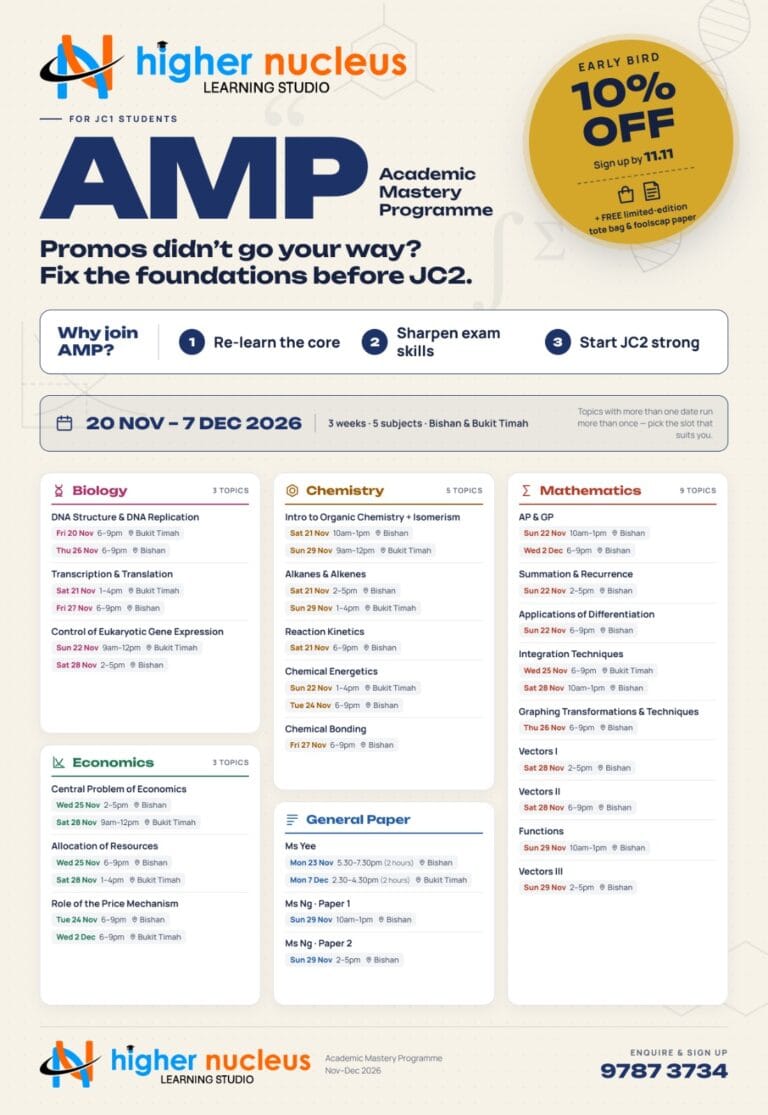
- JC1: Build foundations with a specialist before gaps compound. If promos went badly, revise JC1 topics in AMP, our JC1 revision programme.
- Between JC1 and JC2: Get ahead on JC2 content with the JC2 Headstart Programme.
- JC2: Structured exam technique and timed practice. A crash course alone rarely fixes a gap in foundations.
- Private candidates: Structure matters most when there is no school timetable. See A-Level classes for private candidates and retake or private university.
How Higher Nucleus applies this
Higher Nucleus Learning Studio is a centre led by ex-MOE teachers, and each A-Level subject is taught by its own specialist tutor. Full-time teaching is a requirement for the tutors we hire.
- H2 Economics
Kirby Ng - H2 Mathematics
Terence Chia - H2 Chemistry
Low Kwee Peng and Dr Reginald Thio - H2 Biology
Alex Xu - H2 Physics
Jared Chew and Samuel Neo - General Paper
Ms Ng and Ms Yee Sukyi
Classes are small and run at Bishan (all six subjects) and Bukit Timah (H2 Chemistry, Mathematics and Biology), and any class can be joined live on Zoom. See the class schedules, meet our educators, or read what past students say.
Not sure which type of tutor you need?
Tell us the subject, the JC and the latest grade, and we will tell you honestly whether one of our classes fits.
Frequently asked questions
What makes a JC tutor reliable?
A reliable JC tutor is an experienced specialist in one A-Level subject who teaches to the current SEAB syllabus through a structured programme: a plan that runs across JC1 and JC2, notes they wrote themselves, and written work they mark with specific feedback.
What are the main types of tutor for JC students?
As a general guideline drawn from our own years of tutoring and teaching, there are five broad types: the homework helper, the generalist home tutor, the school-paced re-teacher, the crash-course coach and the specialist subject tutor. Each suits a different need, but for most A-Level students a specialist subject tutor with a structured programme is the safest choice.
Who benefits most from group classes with a specialist tutor?
Students who are willing to learn but need a guiding hand and an extra push. A specialist group class gives structure, deadlines and marked work, but the pace is set for the class and each student gets less one-to-one time, so it works best for students who will do the work between lessons and ask when they are stuck.
Is a student tutor good enough for A-Level subjects?
For a subject you are already coping with, a student or graduate tutor can be a useful homework helper. For a subject you are struggling with, or one you are aiming for an A in, an experienced specialist who has marked many full A-Level scripts and teaches a planned programme is the safer choice.
Does a JC tutor need to be a former MOE teacher?
No. Experience as an MOE teacher is a genuine plus, because it brings classroom and school assessment experience, but it is not a requirement. Check subject specialism, knowledge of the current syllabus and a structured way of teaching first.
How can I tell if a tutor is teaching the current syllabus?
Ask which SEAB syllabus code their notes are written to and check it against your own cohort. For example, JC1 students in 2026 sit the revised H2 science syllabuses in 2027: 9476 Chemistry, 9477 Biology and 9478 Physics. H2 Economics (9570), H2 Mathematics (9758) and General Paper (8881) are unchanged.
Is a tuition centre or a home tutor better for JC?
The tutor matters more than the format. A small group with a specialist adds peers and a fixed programme; one-to-one tuition adds pace. Whichever you choose, apply the same checks: subject specialism, current syllabus, a plan across JC1 and JC2, and marked written work.
Syllabus codes and paper durations are taken from SEAB’s published syllabus documents. Check your own cohort’s codes on SEAB’s GCE A-Level pages.